
Over my years in medicine I have seen many patients who could barely walk across a room without developing crushing chest pain. After two or three weeks on a comprehensive lifestyle program, many of those same patients were walking miles a day, in less pain and on less heart medication than before. The results are often so striking that you would have to see them firsthand to fully appreciate them.
If that sounds too fast to be believable, I understand. For most of my career, the medical community felt the same way. This is the story of why it happens, and it begins with a mystery.
In 1983, Dr. Dean Ornish and his colleagues published a study in The Journal of the American Medical Association in which patients with ischemic heart disease spent just 24 days on an intensive program of a very low-fat, plant-centered diet and stress management training. In under a month, the patients reported a 91 percent average reduction in the frequency of their angina episodes, and their capacity on a treadmill rose 44 percent.1
Seven years later came the famous Lifestyle Heart Trial, published in The Lancet. Patients with significant coronary disease followed a nearly total vegetarian diet of about 10 percent fat, exercised moderately, practiced daily stress management, and met for group support. After one year, their total cholesterol had fallen 24 percent and their LDL 37 percent, without a single cholesterol-lowering drug. In 18 of the 22 patients, sophisticated computer analysis of their angiograms showed movement toward regression of their blockages. The group's angina fell from about five episodes per week to less than one, a 91 percent reported reduction, while the comparison group following standard medical advice reported 165 percent more chest pain than when they started.2
Here is the mystery. The measured change in the blockages, while historic, was modest: the average narrowing improved by about two percentage points in a year. And in the earlier study, symptoms had improved dramatically in 24 days, before any meaningful physical change in a blockage was even possible. The blockages had barely moved. The chest pain had nearly vanished. What was going on?
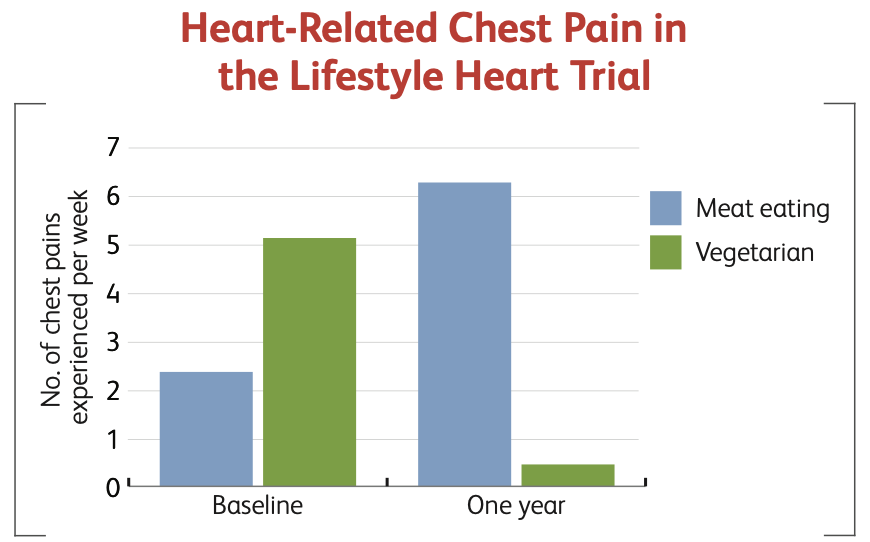
The answer requires giving up the most common mental picture in heart health: the artery as a pipe that slowly scales up like old plumbing until it clogs. As I wrote in Proof Positive, "Healthy arteries are muscular organs that have the ability to control how much blood flows through them by changing their diameter."
Your arteries are active, living tissue. They widen when your body needs more blood delivered and narrow when it needs less, moment by moment, meal by meal. And that widening is not automatic. It depends on a signal.
In 1980, researchers discovered that the thin layer of cells lining every blood vessel, called the endothelium, releases a substance that instructs the muscular wall of the artery to relax.3 That substance turned out to be nitric oxide, and the discovery earned the Nobel Prize in Medicine. I have described the endothelium as "the war zone in cardiovascular disease," because this delicate single-cell lining is where the battle for your circulation is won or lost.
When nitric oxide is abundant, arteries dilate easily, blood flows freely, and the heart pumps against less resistance. When the signal weakens, vessels stay tight and narrow even when the body is calling for more blood.
Cholesterol, it turns out, does damage long before it forms a blockage. In research published in The Journal of Clinical Investigation, people with elevated cholesterol showed measurably weaker artery relaxation than people with normal levels, even in vessels with no obstruction at all.4
How quickly can this change? In a revealing study in The Lancet, researchers took patients off their cholesterol-lowering medication. Within two weeks, nitric-oxide-driven vessel relaxation was measurably impaired. Then came the detail I find most fascinating: when the researchers infused L-arginine, the amino acid the endothelium uses as raw material for nitric oxide, the impaired relaxation returned to normal.5 Keep that amino acid in mind. It will come up again shortly.
Laboratory and animal studies suggest one reason cholesterol interferes: oxidized LDL cholesterol activates an enzyme called arginase, which consumes the very L-arginine that vessels need to make nitric oxide.6 The damaged signal is not a mystery of aging. It has causes, and causes can be addressed.
L-arginine is found throughout the food supply, but not evenly. Beans, nuts, and seeds are among its richest sources. A cup of roasted soybeans delivers more than 20 times the arginine in a glass of milk, and roughly three times that of a sirloin steak.
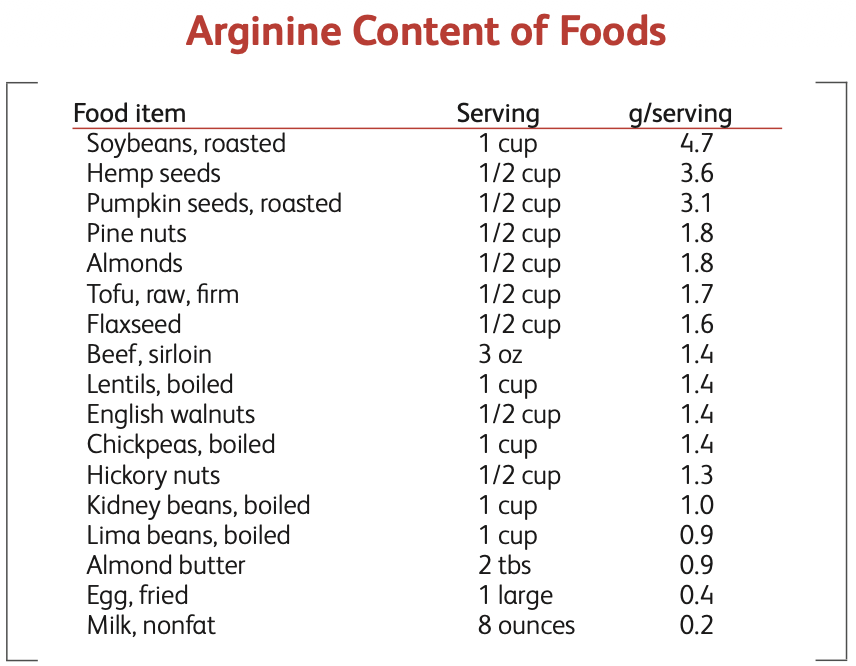
Does an eating pattern built on these foods show up in the arteries? In a small but intriguing study published in Atherosclerosis, researchers compared adults over 50 who had followed a vegetarian diet for at least a year with closely matched meat eaters. The vegetarians' arteries relaxed and dilated significantly better, and the longer a person had eaten that way, the better their arteries performed.7 It was a study of only 40 people, so I hold the finding loosely, but it points in the same direction as everything else we have seen.
There is a second, entirely separate route to nitric oxide, and it explains one of the stranger sights in modern athletics: world-class athletes drinking beet juice. Vegetables rich in nitrates are converted, through your saliva and helpful oral bacteria, into nitrite and then into nitric oxide.8 In controlled human trials, beetroot juice lowered systolic blood pressure by roughly 10 points within hours, and dietary nitrate reduced the oxygen cost of exercise while extending time to exhaustion by 16 percent.9,10
Which foods carry the most? The ranking surprises most people. Beets are famous, but they do not lead the list.
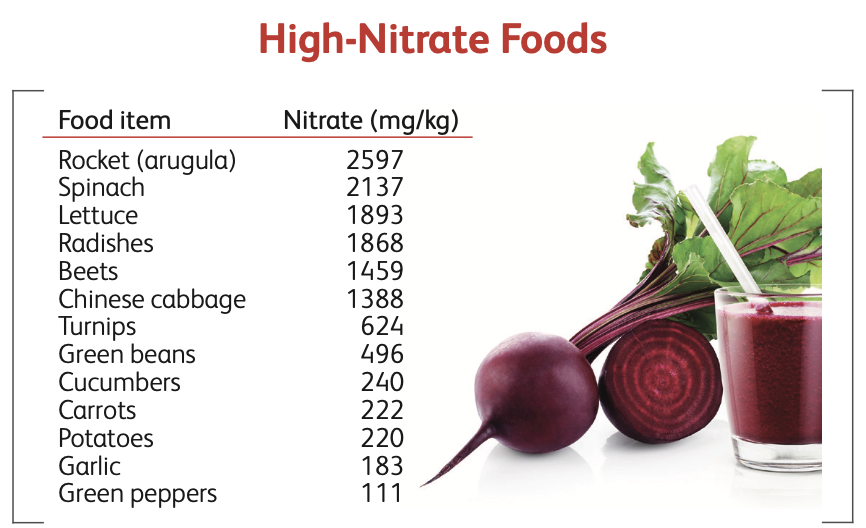
Values are typical published averages; nitrate content varies with season and growing conditions.11
This is not a distant promise. In a randomized crossover trial in the journal Nitric Oxide, a single spinach-rich meal improved large-artery elasticity and lowered systolic blood pressure within hours compared with a matched low-nitrate meal.12
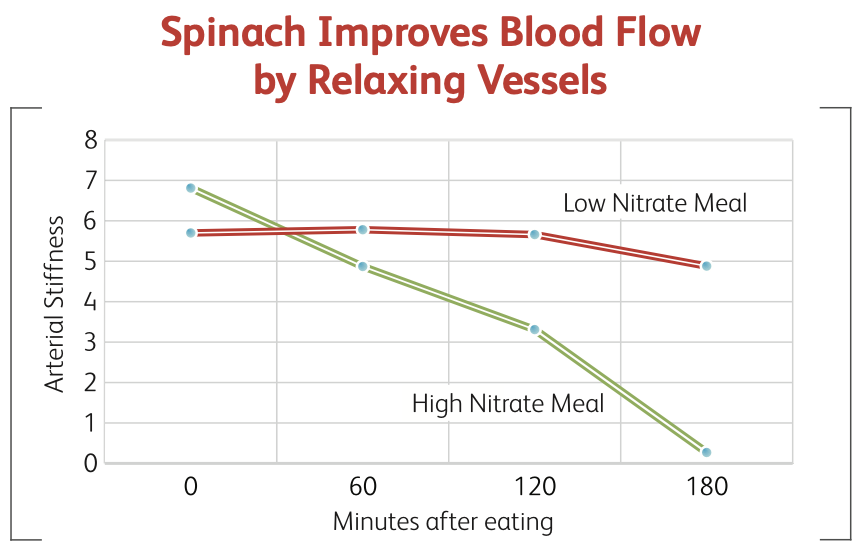
Now, you may be thinking: haven't I heard that nitrates are bad? It depends entirely on the package they arrive in. Nitrites in processed meats can form nitrosamines, compounds implicated in the World Health Organization's classification of processed meat as carcinogenic.13 Vegetables deliver their nitrates alongside vitamin C and polyphenols that block that conversion. In fact, United States regulations require ascorbate, a form of vitamin C, to be added to conventionally cured bacon precisely to limit nitrosamine formation. Yet laboratory studies of digestion suggest that in the presence of abundant fat, that added vitamin C loses its protective effect.14 The same molecule, in one food, feeds the chemistry of damage; in another, it feeds the chemistry of healthy blood flow. The difference is what surrounds it.
Nitric oxide has one great weakness: it is chemically fragile. Excess free radicals destroy it almost on contact, which is one reason the endothelium, working in that war zone, depends so heavily on antioxidant defense. Notice that this is built into plant foods by design. The same vegetables that supply the nitrates also deliver the antioxidants that protect the finished signal.
One fruit has become a particular focus of this research: amla, the Indian gooseberry, among the most antioxidant-dense fruits ever measured in the laboratory. In a 12-week randomized, double-blind, placebo-controlled trial, adults with metabolic syndrome who took 1,000 mg per day of a standardized amla extract saw their serum nitric oxide levels rise by roughly 51 percent, alongside a 53 percent rise in glutathione, the body's master antioxidant, and a 31 percent drop in a key marker of oxidative damage.15 The lesson runs in one consistent direction: shield the endothelium from oxidative stress, and it makes more of the signal that keeps blood moving.
Exercise works on the endothelium directly. In humans, regular training measurably augments nitric-oxide-dependent vessel relaxation, and lifelong exercisers maintain more elastic arteries as they age.16,17 Emerging research in animals and early human studies suggests exercise even mobilizes progenitor cells that help repair the vessel lining itself.
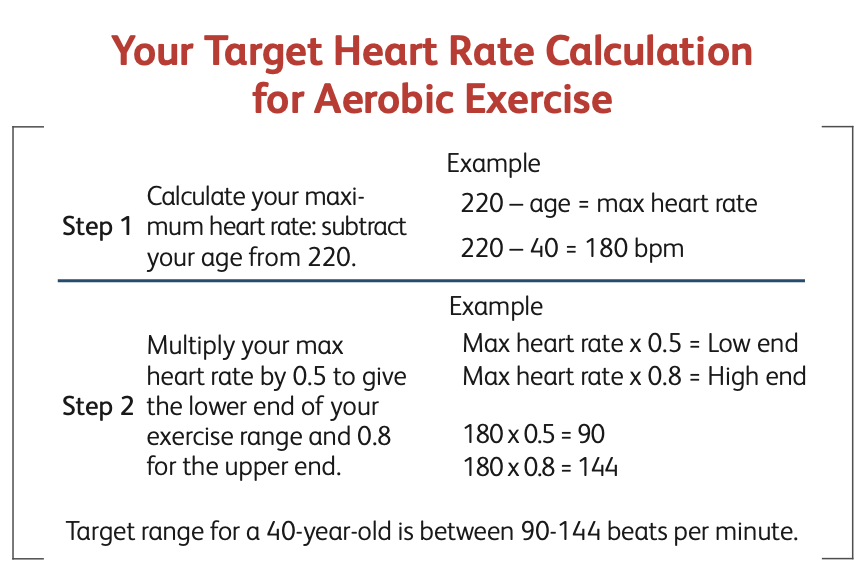
The prescription from the Lifestyle Heart Trial was refreshingly modest: walking at least three hours a week, in sessions of 30 minutes or more, at a moderate intensity.2 A common way to gauge that intensity: subtract your age from 220 for an estimated maximum heart rate, and aim for 50 to 80 percent of it. For a 60-year-old, that is a heart rate between roughly 80 and 128, a purposeful walk, not a race.
And now the mystery resolves. Blood flow does not rise in simple proportion to a vessel's diameter. By the physics of fluid in a vessel, flow rises with the fourth power of the diameter. Open an artery a little, and flow increases a lot. When the Lifestyle Heart Trial team analyzed their most severely narrowed arteries, the modest improvements in geometry translated into roughly 45 percent better blood flow capacity.18
This is why patients feel different in weeks, not years. Long before a blockage physically shrinks, vessels that regain their ability to relax deliver dramatically more blood. The pipe model says change takes decades. The muscle model says the signal can improve now. The muscle model is the true one, and it is the most hopeful fact in cardiovascular medicine.
One more reason I care so much about this subject: the endothelium does not stop at the heart. The brain is among the most blood-hungry organs you own, and the same process that stiffens coronary arteries quietly restricts cerebral blood flow. In long-term studies, elevated cholesterol in midlife has been associated with roughly one and a half times the risk of Alzheimer's disease decades later, an association worth taking seriously even though it does not prove causation.19 And this process starts early: autopsies of young American soldiers, average age 22, found that 77 percent already had visible coronary atherosclerosis.20 The time to care for your arteries is not after the first symptom. It is now.
Everything in this article points to steps that are within reach today:
The amla research described above is the reason we formulated Circulation, our newest supplement, around Capros® amla extract at 1,000 mg per day, the same daily amount used in that 12-week trial. Circulation is designed to support healthy circulation, blood-vessel function, and cholesterol levels already within the normal range, as one part of the whole-person approach described in this article. The foundation is always the plate and the walking shoes. If you would like targeted support alongside them, that is what we built it for.
Explore Circulation by Nedley Health →
Dr. Neil Nedley, MD is a practicing physician with 40 years of clinical experience in internal medicine, specializing in mental health, mood, and cognitive performance. He is the founder of Nedley Health and the author of Proof Positive, The Lost Art of Thinking, and Depression: The Way Out.
*These statements have not been evaluated by the Food and Drug Administration. This product is not intended to diagnose, treat, cure, or prevent any disease. Always consult your physician before starting any supplement, especially if you take medication or have a medical condition.